Today’s show is, “Secrets of Phrasing: How to Approach Two Note Slurs on the Piano”. There are two aspects of phrasing. The terms are sometimes used interchangeably, but there are two distinct meanings. One meaning of phrasing is how yo
The question today is: How do you play staccato on the piano? You may think of staccato as playing notes short. Indeed, in most contexts, that’s exactly how staccatos are played. However, staccato actually means to play detached, in contrast to
What techniques can you use in your practice of this work and other pieces of Beethoven?
You should practice in chords whenever possible. Learning to play your music in chords can be very beneficial. This aids in a number of ways. First, by reducing the music to chords, you will understand the harmonies. More than that, you will discover fingerings that accommodate the notes well. It also makes it easier to learn.
It’s important to bring out the melody which is typically in the right hand. One technique for achieving this is to play the accompanying parts staccato with a light wrist when the texture allows for it.
Another important aspect of practicing effectively is to work out your trills. It isn’t important to play a large number of notes. It is essential that you work out exactly the number of notes you can play with confidence. This will result in a musical execution.
Beethoven didn’t write out many of the dynamics in this piece. However, many editions offer suggestions for expression. For example, you can start this piece forte. In different editions of the piece, people will suggest certain dynamics and while no version is necessarily better than others, you should find something to create contrasts with the music to keep the performance compelling.
Obviously, these are not the only aspects to learning this piece or any work of Beethoven. But they will provide a good foundation for progressing through the music to bring it to a higher level.
Thanks again for joining us here at Living Pianos. If you have any questions about this topic or any others, please contact us at: Info@LivingPianos.com (949) 244-3729
This is a great piece of music for students to learn. It is not a simple piece of music by any means, but it’s one of the easiest Beethoven Sonatas to learn and it is a substantial work. It’s interesting to know that the Op. 49 sonatas were compo
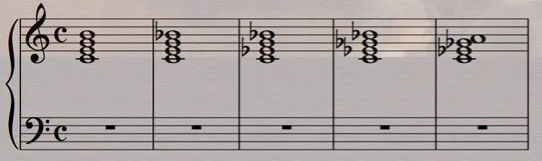
You’ll start with a Major 7th Chord, the Dominant 7th Chord, the Minor 7th Chord, a Half-Diminished 7th Chord, and then finally a Diminished 7th Chord.
But this is just the beginning of what we are going to do! In both hands you will be playing broken chords and you will be playing every other note in each hand and play in contrary motion. So it looks like this:
Is this the end? Not at all! You’re going to go through all twelve keys going up a half-step at a time until you reach C an octave higher. This will be challenging to learn, but once you get the hang of it, this will be an incredibly beneficial exercise for you and one that will help you build strength in your piano playing and independence of your fingers.
Another thing to keep in mind is that you don’t have to play this exercise fast in order to gain benefit from it. Play it at a comfortable speed and work up the tempo gradually over time. This exercise will take time to master, but keep at it and you will get results.
Thanks again for joining us here at Living Pianos. If you have any questions or comments about this topic or any topic at all please contact us directly Info@LivingPianos.com or (949) 244-3729.
One of the most common questions I get is how to build strength on the piano. This is a tough topic because practicing the wrong way can potentially lead to injury, so you must always be aware of how you feel. The fact is, there is no simple method t
An early form of jazz music, created just before the turn of the 20th century, ragtime is a popular form of music that you’ve undoubtedly heard many times. Some ragtime music is completely written out (like Classical concert music) and other times it is more of an improvised style of music. You might be familiar with the rags of Scott Joplin who is probably the most famous Ragtime pianist known for The Entertainer as well as other music.
Ragtime is typically associated with a fast and upbeat style of music. However, Scott Joplin himself was quoted as saying, “Ragtime should never be played fast”. Is there a right or wrong speed or tempo of this music? Like most things from different eras, it’s open to interpretation. Some people prefer ragtime slower, while some prefer a faster tempo. The bottom line is enjoying the music and making it your own.
Another common misconception about ragtime is that it should be played with a “swing” feel to the music in which the notes are played with a long-short emphasis on each 2 note group. This style became popular decades later. What does differentiate ragtime music from other genres is the syncopated rhythms which are played off the beat of the music. When you listen to ragtime you’ll find it almost impossible not to move because of the bouncy quality of the syncopation. It makes you want to dance!
What’s fun about ragtime is that you can take nearly any song or piece – old, contemporary, Classical, whatever you can imagine – syncopate the rhythms and play it in a ragtime style. If you have a chance to watch the video provided with this article you’ll see Jonny play some amazing examples of taking popular music from different eras and turning them into ragtime.
The alternating octaves and chords in the left hand in ragtime are one of the biggest technical challenges for most people approaching this style of music. This is a technique rarely used in Classical music with some notable exceptions, such as the end of the 6th Hungarian Rhapsodie of Franz Liszt. So, what advice did Jonny give us? Simplifying the music is a great way to get yourself acclimated to playing ragtime. Jonny recommends using shorter jumps between octaves and chords and possibly leaving out some notes until you get comfortable with the style. Jonny also recommends watching your left hand as opposed to the right hand since the left hand will be jumping from octave to chord back and forth while the right hand stays relatively in the same position.
Another thing that’s so fascinating about ragtime music is that almost every piece contains a melancholy section. No matter how happy the piece is, there always seems to be a section that changes the mood. It’s a great compositional technique that adds depth of emotion to the music.
Ragtime was developed in the late 1800s through the early 20th century and really hit it’s stride around 1898 with the release of Maple Leaf Rag. It was a very popular form of music in it’s day and contemporary composers from that time would sometimes write rags or rag-style music into their pieces – such as Debussy’s Golliwog’s Cakewalk and some music of Gershwin.
Thanks again for joining us here at Living Pianos. If you have any questions about this topic or any topic at all please contact us directly: Info@LivingPianos.com (949) 244-3729
We are very happy to welcome our guest Jonny May www.PianoWithJonny.com on this video. Jonny is an expert at Ragtime music who will share his music and knowledge with us. An early form of jazz music, created just before the turn of the 20th century,
Asking if there is a right or a wrong way to learn the piano is a really loaded question. There is no clear cut answer but I’m going to try and answer this the best I can based on my experience. I’ve had the opportunity to study with several grea